01
Free consultation
We talk about your operation, in person in the Bajío region or by video call everywhere else, and identify what to fix first.
We build the system for your packing house, freezer plant or food processing plant around the way you already work: grower receiving at the scale, lots and labels, cold storage, shipments and grower settlements. If a customer complains about a box, you know within minutes which grower, which orchard and which day it came from, and who else received that lot.
Companies that already trust Nightly














The problem
If any of these sound familiar, it’s worth a conversation. The consultation is free.
Boxes get mixed on the line, and when something goes wrong, nobody can say which orchard or which day they were from.
Each delivery’s weight is written down by hand next to the scale, and someone types it into Excel days later, with mistakes.
Pulling together each grower’s weights, advances and deductions eats up the week, and there’s always a difference to argue about.
You know there’s product, but not how much of each lot or since which day, and the oldest stock stays at the back.
When a buyer asks about a lot, half the team drops what they’re doing to dig through paperwork and phone photos.
What the packing list says isn’t what went on the trailer, and you find out once the customer already has it.
What’s included
According to figures from COFOCE, Guanajuato’s export promotion agency, fresh broccoli was the vegetable the state exported most in 2023, at US$352 million, and 91.2% of the state’s farm-product exports went to the United States. When you sell at that level, every box has to be able to tell its story. The system records each step once, starting at the scale, so the answer to a complaint comes in minutes instead of from a stack of paper. We start with what you need most, receiving or cold storage, and add the rest in stages.
Every delivery with its weight, grower, orchard or plot, date and quality, captured at the scale instead of in a notebook.
Every delivery and every packing run gets its lot and a barcoded label that travels with the box and the pallet until they ship.
Stock by room, lot and day in, so the oldest product ships first and nothing gets forgotten.
Packing list, lots, temperature and invoice in a single record per shipment, ready to send to your customer.
Each grower’s weights, advances and deductions, with an account statement ready to go over with them.
From a box to the grower who harvested it, and from a lot to every customer who received it, in minutes.
In detail
The critical point is preserving relationships between lots, even when they are mixed, split or repacked.
Illustrative example: a packing run uses raw material from lots A and B and creates two finished-product lots, C and D. Part of C ships to a customer and the rest stays in cold storage. Looking up A should lead to C and D, their available quantities and shipments; looking up C should lead back to A and B. Putting the same reference on every label is not enough.
| Test with your records | Result to check |
|---|---|
| Receiving and transformation | Grower, date, weight and input lot linked to output lots and recorded waste. |
| Split a pallet or repack | Each new unit retains its relationship to the lot and quantities are not duplicated. |
| Partial shipment, rejection or return | Cold-storage stock matches what shipped, returned or was set aside. |
| Look up an origin lot | You can distinguish customers who received it, shipments and product still available. |
Bring a receiving record, packing run, label and shipment list to the consultation. For a scale or sensor connection, we need its make, model and how its data can be obtained; manual entry is also defined explicitly. Offline capture, syncing and correcting a weight are scoped for your operation.
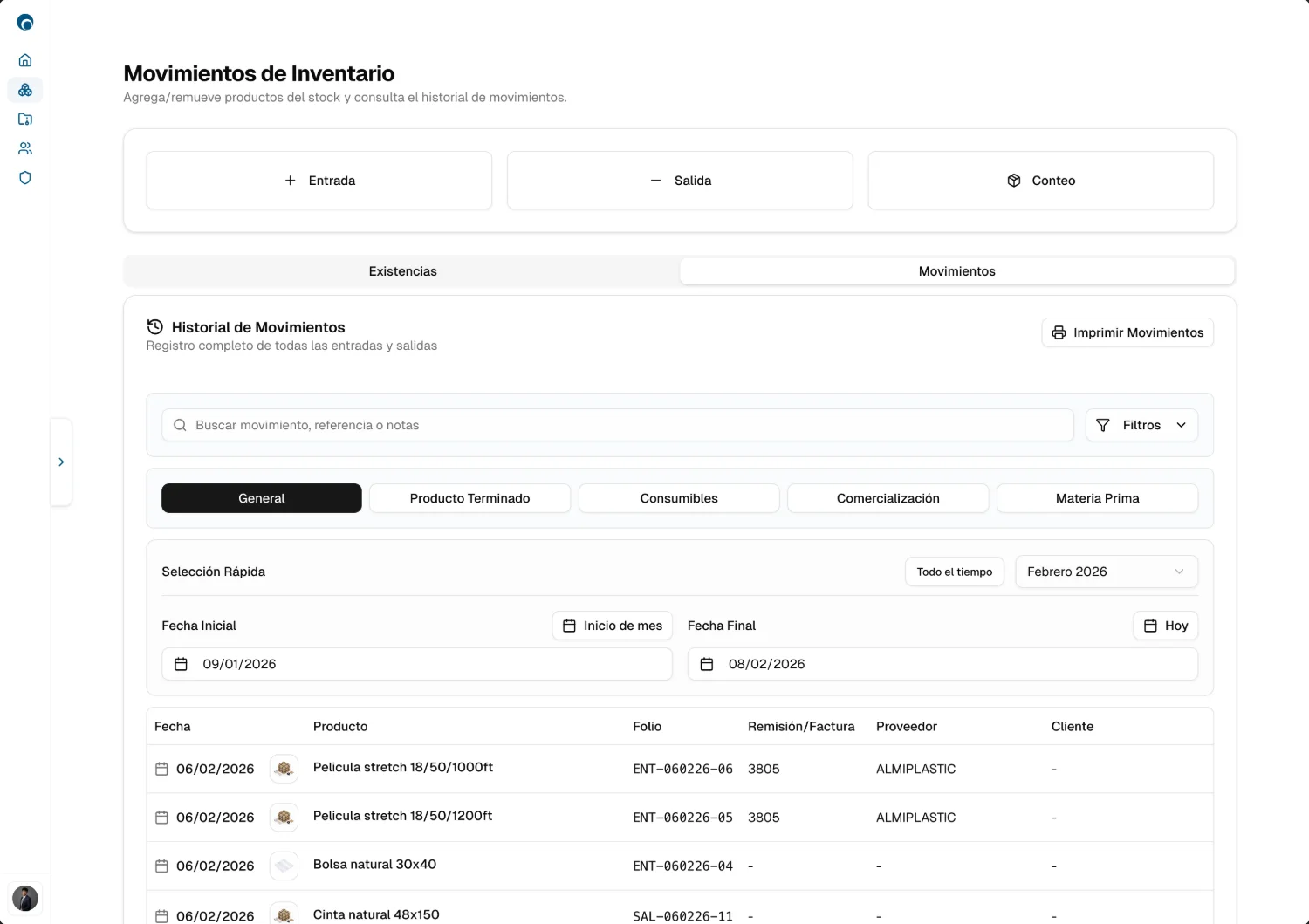
The first stage may cover receiving and stock by lot, or one receiving-to-shipment workflow. Agree on what information goes in, what report comes out and who validates it. Our public production and inventory reference is Polymer for Sumiplas, a plastic-bag manufacturer; that case demonstrates manufacturing work without presenting it as a food-safety project.
In detail
What the FDA’s pages say today about its traceability rule, checked on October 5, 2026.
The FDA’s Food Traceability Rule, known as FSMA 204, requires keeping key data at each step a food goes through: harvesting, cooling before initial packing, initial packing, shipping, receiving and transformation. If the FDA asks for those records, they have to be provided within 24 hours.
The rule covers the foods on its Food Traceability List, including fresh cucumbers, peppers, tomatoes, herbs, leafy greens and melons, plus fresh-cut fruits and vegetables. Fresh strawberries and fresh broccoli are not on the list today.
According to the same FDA page, Congress directed the FDA not to enforce this rule before July 20, 2028. The rule has exemptions and requirements that depend on the food and each business’s activities; your adviser should check which apply to you. This date concerns this recordkeeping rule and does not replace other export requirements or what your buyer already requests.
In Mexico, SENASICA, the national agri-food safety agency, certifies fruit and vegetable growing operations and packing houses that apply its Contamination Risk Reduction Systems (SRRC, in Spanish). The system keeps the records your program asks for, with their date and the name of whoever entered them.
Pricing
Starting-price references. The exact price comes in writing within 1 business day of the free consultation, and you pay in stages, not for the whole system up front.
How we work
No commitment and no jargon. You get a written proposal within 1 business day of the consultation.
01
We talk about your operation, in person in the Bajío region or by video call everywhere else, and identify what to fix first.
02
You get a written proposal within 1 business day of the consultation, with the scope, price and timeline split into stages.
03
We build in stages, you review progress at every delivery and we keep improving the system with you.
Projects
In writing
That’s what our terms say · How we work
We fix, at no cost, anything that doesn’t work as agreed and that you report within 60 calendar days of each delivery.
You can ask us for a full export at any time, including when the project ends.
We use what you share about your business only for your project and, if you need it, we sign a confidentiality agreement before we start.
If you ask for something outside the proposal, we first tell you in writing how it changes the price and dates, and we only do it if you approve.
When each stage arrives, you review it and tell us anything that doesn’t match what we agreed. We fix that at no cost.
Let us know in writing and you pay only for the work done up to that day.
What business owners ask us before getting started.
Whatever your operation needs, in stages. Most companies start with receiving at the scale: every delivery with its grower, orchard, weight and quality, plus its lot label. Next come cold storage by lot and date, packing by run, shipments with their packing list and grower settlements. Everything stays connected: the label you print at the scale is the same one you look up when a customer complains. If you track stock in Excel or another system today, we bring that information over so you don’t start from scratch. To see how we handle lot control in other industries, check our inventory management system and production control software.
A single module, such as scale receiving or grower settlements, can start from about $5,000 MXN. Receiving, lots and cold storage connected, from about $15,000 MXN, and a complete system that adds shipments and traceability from grower to customer, from about $25,000 MXN, paid in stages. Adjustments and support start at $600 MXN per hour. You get the exact price in writing within 1 business day of the free consultation, with what each stage includes and its delivery date. To compare against subscription software, read how much an inventory system costs.
It helps you keep the data ready. The FDA’s traceability rule requires records at harvesting, cooling, packing, shipping and receiving for the foods on its list, and providing them within 24 hours if the FDA asks. In what records the FDA requires, higher up on this page, we explain which products it covers today and when it will be enforced. The system captures that data at each step and pulls it into a report by lot or by shipment. We don’t give legal or food-safety advice: exactly what to record is up to your advisor or what your buyer asks for.
Every step leaves a trail with the same lot number. At the scale, the delivery gets its lot with grower, orchard and harvest date. When packing, the run records which incoming lots it used and creates the finished-product lots with their labels. In cold storage, every pallet knows where it is and since when. At shipping, the system records which pallets and lots went on each trailer and for which customer. That lets you go backward, from a box to the grower, or forward, from an incoming lot to every customer who received it. It’s the same logic as Polymer, the system we built for Sumiplas, a plastic bag manufacturer: there they see each production order’s progress in real time, with raw materials, supplies and finished goods kept up to date. If you want to start organizing your cold storage right away, read our inventory control guide.
Yes. Every weighing is recorded under its grower with its price, or with your price table by quality, and the system adds up what was received that week or that season. You subtract the advances you gave and the agreed deductions, such as rejects or shrinkage, and out comes an account statement ready to go over with the grower and send as a PDF or on WhatsApp. Since every figure comes from the scale and not from a notebook, a difference gets cleared up by looking at the weighing, not by arguing from memory. How payments and invoices are handled is still up to your office.
It can be designed to. If the signal drops at your scale, in the field or inside the cold room, the system can capture data offline and sync it when the signal comes back. That’s how Ventrack, our point-of-sale system, works: it keeps ringing up sales when the internet goes down, stores offline sales encrypted and syncs them when the connection returns. If your operation needs it, we settle it in the consultation, along with the right equipment: a tablet, a phone or the computer you already have next to the scale.
That works too. According to INEGI’s 2024 Economic Census summary for Guanajuato, the food industry was the state’s second-largest manufacturing subsector by value added in 2023, behind only transport equipment. In a food plant, the system tracks raw-material and finished-product lots, expiration dates, each product’s formula and the shrinkage from every run. For the production side, our reference is Polymer, the Sumiplas system, which measures efficiency by machine and material waste to spot where material is being lost. And if you also sell to the public, Matilda, a bakery and café in Irapuato with several locations, now takes online orders by location, for pickup or home delivery, on a platform we built for it.
Yes. We’re based in Irapuato and come in person to your packing house, freezer plant or food plant in Irapuato, Celaya, Salamanca, Silao, León, the city of Guanajuato, Querétaro or Aguascalientes. We look at the scale, the cold room and the loading dock with the people who run them, because that’s where you decide what to fix first. If your operation is in another state, we work by video call. If your company is in Irapuato and you need more than agribusiness, also see our page on custom software in Irapuato.
We’ll tell you what to fix first and what it would cost. We reply the same business day.