01
Free consultation
We talk about your operation, in person in the Bajío region or by video call everywhere else, and identify what to fix first.
A system built to fit your shoe factory: orders by style, color and size run, the materials each order needs, every batch’s progress by department, each worker’s piece-rate pay and the work you send out to outside shops. For factories that track all of that in Excel, notebooks and WhatsApp messages today. We visit you in León and across the Bajío, and we deliver it in stages.
Companies that already trust Nightly














The problem
If any of these sound familiar, it’s worth a conversation. The consultation is free.
Each order arrives with its style, color and pairs per size, and someone rewrites it on the cutting order.
To know whether you have enough material, someone works it out on a calculator or from memory.
A batch leaves cutting, and nobody knows whether it’s in stitching or still sitting in a corner of the shop.
Each worker’s pairs are written on paper, and on Friday someone adds it all up for payroll.
Outside workshops take stitching or finishing work, and to find out how many pairs they owe you, someone calls them one by one.
Every collection starts with a new file of styles, materials and prices, and last season’s mistakes come back.
What’s included
Footwear software has to speak your factory’s language: style, color, size run, batch, department and pair. We start where you lose the most time or material today and add the rest in stages while your people keep producing.
Each order with its style, color and size run, and the pairs in every size: for example, a women’s style from size 22 to 26 (Mexican sizing).
How much leather, lining, soles, lasts and trims the order needs, how much is in stock and what you still have to buy.
Each batch with its number and the department it’s in: cutting, stitching, lasting or finishing, visible from the office.
Pairs logged by operation and by person, with the weekly report ready for payroll. Stamped payroll stays in your payroll software.
Which batch went to each workshop, how many pairs, when it comes back and what you owe for what it delivered.
Stock by style, size and color, and orders from shoe stores and distributors through a portal with their own prices.
In detail
This is what an order looks like in the system. The style and quantities are illustrative.
| Style and color | 22 | 23 | 24 | 25 | 26 | Pairs |
|---|---|---|---|---|---|---|
| Women’s style 1520, black | 6 | 12 | 18 | 12 | 6 | 54 |
| Women’s style 1520, tan | 4 | 8 | 12 | 8 | 4 | 36 |
With those 90 pairs, the system works out the leather and lining from each size’s consumption, sets aside soles and lasts by size and opens the cutting batches. If a material falls short, it warns you before cutting, not once the batch is stuck in lasting. Later, the same order shows how many pairs of each size are finished and how many are still to ship. Sizes follow the Mexican system.
In detail
What the system tracks in each part of your factory. You can start with one and add the others later.
In detail
Use a real collection order, with its sizes and materials. These sample tests help define the first stage.
| Test | What you should be able to verify |
|---|---|
| Change an order’s size run | Pairs by size, the total and required materials are recalculated from your consumption sheet. |
| Send only part of a batch to stitching | Pairs sent, received and outstanding stay separate, by size and subcontractor. |
| Record a rejection or rework | It remains distinct from a finished pair and a supervisor can check what counts toward piece-rate pay. |
| Ship and return finished goods | Stock updates by style, color and size, retaining the link to the order. |
For the consultation, prepare a size run, a consumption sheet by size, pay rates for each operation and a subcontracting dispatch. Note how each material is purchased and consumed: leather measured by area needs different rules from soles counted by pair. If your files use different names for the same style, agree on a catalog before importing data.
Start with orders and finished goods if fulfilling by size is the problem, or with batches and subcontracting if progress gets lost between workshops. To connect purchasing, sales and balances too, see custom ERP; to evaluate the shop floor alone, see production control.
Pricing
Starting-price references. The exact price comes in writing within 1 business day of the free consultation, and you pay in stages, not for the whole system up front.
How we work
No commitment and no jargon. You get a written proposal within 1 business day of the consultation.
01
We talk about your operation, in person in the Bajío region or by video call everywhere else, and identify what to fix first.
02
You get a written proposal within 1 business day of the consultation, with the scope, price and timeline split into stages.
03
We build in stages, you review progress at every delivery and we keep improving the system with you.
Projects
We don’t publish the client’s name.
In writing
That’s what our terms say · How we work
We fix, at no cost, anything that doesn’t work as agreed and that you report within 60 calendar days of each delivery.
You can ask us for a full export at any time, including when the project ends.
We use what you share about your business only for your project and, if you need it, we sign a confidentiality agreement before we start.
If you ask for something outside the proposal, we first tell you in writing how it changes the price and dates, and we only do it if you approve.
When each stage arrives, you review it and tell us anything that doesn’t match what we agreed. We fix that at no cost.
Let us know in writing and you pay only for the work done up to that day.
What business owners ask us before getting started.
Whatever your factory uses, and not all at once. The most common pieces are: orders by style, color and size run that turn into production batches; material requirements for each order, checked against your warehouse; each batch’s progress by department; each worker’s piece-rate pay; tracking for outside workshops; and finished-goods inventory by size and color, tied to your customers’ orders. Each piece works on its own, so you can start with the one that hurts most. We explain how a custom inventory management system works and how we track orders with production control software on their own pages.
It’s priced by what we build, not per user. A single module, such as size-run orders or piece-rate pay, starts from about $5,000 MXN. Connected production and inventory, with material requirements, from about $15,000 MXN. The complete system, with orders, materials, batches, piece rate, outside shops and sales, from about $25,000 MXN, and you pay for it in stages. Later adjustments and support start at $600 MXN per hour, and hosting and maintenance are agreed in writing. Within 1 business day of the free consultation, we give you the exact price in writing, broken down by stage. If you’d like to compare it with ready-made inventory software first, read how much an inventory system costs.
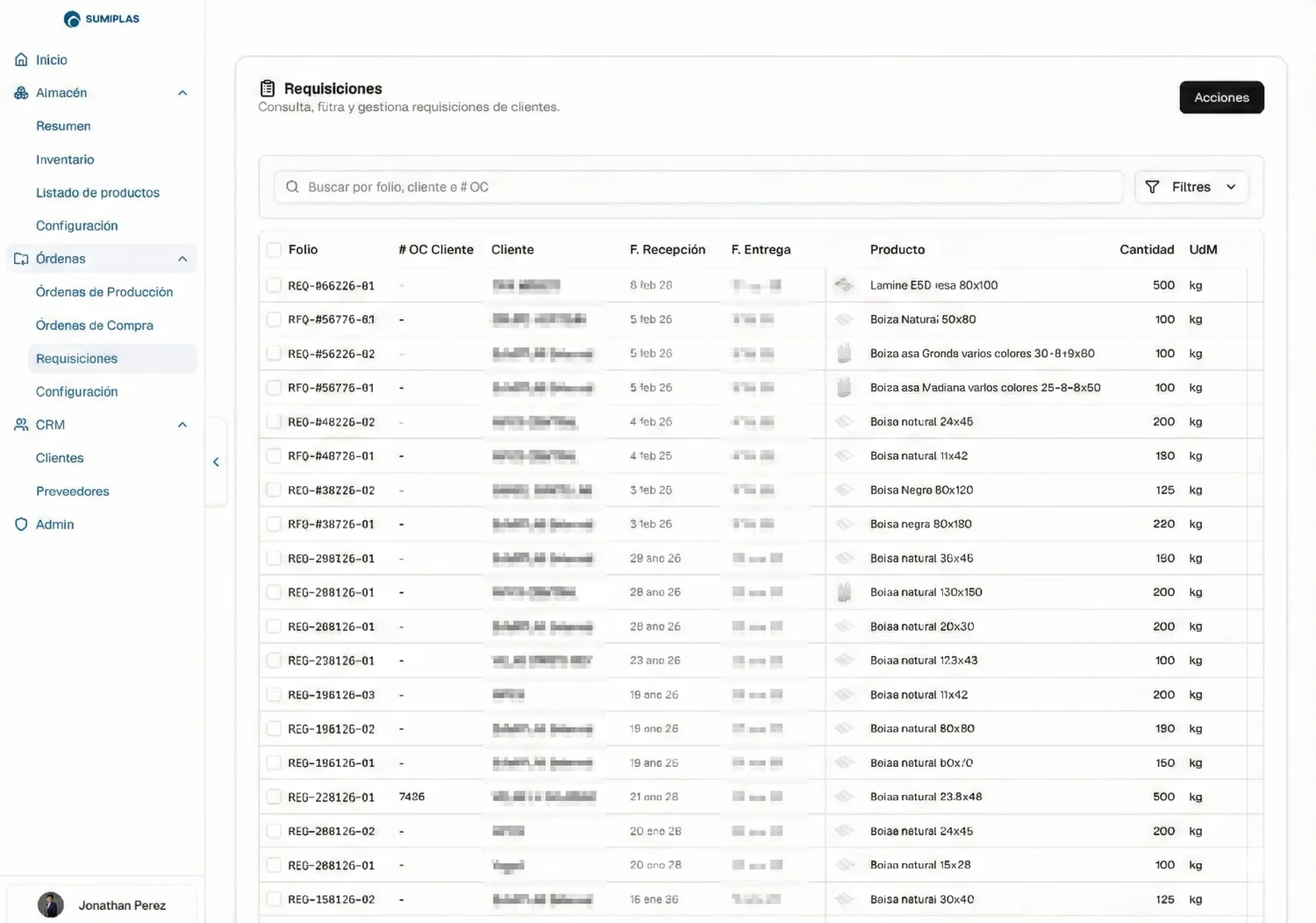
Yes. We built the ERP and inventory system for a footwear manufacturer in León, Guanajuato; we don’t publish the client’s name. For a public production and inventory reference, there’s Polymer, the system we built for Sumiplas, a plastic bag manufacturer. In the consultation, we work out what to solve first in your factory.
Each style has its sizes and its size runs, for example a women’s run from size 22 to 26, or whichever you use, with half sizes if you make them. When you enter an order, you pick the style, the color and the run, and the system splits the pairs by size; if a customer asks for a different run, you change it on that order only. From then on, everything is counted by size: cutting batches, materials, finished goods and what’s left to ship. So you know how many brown pairs in size 24 are in the warehouse and how many are already set aside for a customer.
Yes. For each style, you record its standard consumption by size: how much leather and lining it takes, in the unit you buy them in, which sole and last for each size, and which trims, such as laces, eyelets or insoles. With that, the system runs the material requirements for one order or a whole week, checks them against your warehouse and tells you what to buy before cutting. When each batch closes, cutting logs what it really used, and the difference against the standard is your waste, by style and, if you record it, by cutter. Measuring where material gets lost is what the performance and waste analysis in Polymer, the system we built for Sumiplas, does.
Each batch goes out with a number, the style, the sizes and the number of pairs. At each step, such as cutting, stitching, lasting and finishing, whoever receives it marks on a tablet or phone when they started and when they finished, and logs any pairs that came out wrong. That way you know which step each batch is on without walking the floor, how much material was used against the plan and which distributor orders will be late before they call you. At the end, shipping deducts the finished goods from inventory by size and color. For a manufacturing reference, see Polymer, the system we built for Sumiplas. The full method, step by step, is in production tracking without walking the floor.
It works it out without a notebook. Each operation has its rate per pair, or per dozen if that’s how you pay: cutting, stitching, lasting or finishing. Whoever finishes their part of a batch logs it on their department’s tablet with their name and the pairs, and the supervisor approves it. At the end of the week, the system adds up what each person did and what they’re owed, with the detail by batch in case anyone asks. You use that report for payroll; stamped payroll receipts (CFDI) are still issued from your payroll software, and if that software allows it, we pass it the totals so nobody types them again.
Yes. When a cut batch goes out to a stitching workshop, the system records which batch it is, how many pairs it holds, which trims you sent with it, which workshop it went to and when it’s due back. When it returns, you log how many pairs came back right and how many came back with defects, and the system warns you about anything running late. With each workshop’s rate per pair, you know what you owe it for what it delivered, without relying on the notebook of whoever handles the outside work. The same applies if you send out finishing or any other step.
Yes. Each shoe store, distributor or catalog seller logs in, sees the styles available by size and color at their own prices, and sends you orders without having to call. You see what’s committed, what still has to be produced and how much each customer owes you. That’s what we did, in another industry, for CelMex Unlockers: its customers see each order’s status in real time, and their balances keep a full history. We explain how a portal like that is built on customer portal. And if you also run your own store, Ventrack, our point-of-sale system, costs $990 MXN a month with inventory by location.
Yes, within what your version allows. If you invoice and keep your books in one of them, you don’t have to switch: the factory system passes it what it needs, such as shipped orders or material receipts, so nobody enters the same thing twice and your invoices (CFDI) go out just as they do today. In the consultation, we check your version and plan and tell you in writing what can be connected and what can’t.
Yes. We’re based in Irapuato and visit factories in León and the rest of the Bajío in person. On the visit, we walk the factory with whoever runs it, from the moment an order comes in until the shipment leaves, through the warehouse and every department, and there we decide what’s worth solving first. If your factory is outside the Bajío, the consultation happens by video call. For León companies in other lines of business, such as tanneries, automotive suppliers or retailers, see custom software in León.
Because a shoe factory doesn’t run like just any plant: a single style multiplies into colors and sizes, materials are calculated by size and much of the labor is paid by the pair. And in Guanajuato, it’s a big industry. According to the state government, 75% of the footwear made in Mexico comes from Guanajuato, from more than five thousand companies, most of them micro and small businesses, and in 2026 the industry marks 100 years as an organized industry. According to INEGI’s 2024 Economic Census, footwear manufacturing is the fifth-largest branch of the state’s economy by value added. If generic software doesn’t handle size runs or piece-rate pay the way you do, you end up with a spreadsheet on the side; a custom system starts from how you already work.
We’ll tell you what to fix first and what it would cost. We reply the same business day.