01
Free consultation
We talk about your operation, in person in the Bajío region or by video call everywhere else, and identify what to fix first.
If you make parts, do contract manufacturing or supply another plant, you need to be able to say which batch went into each shipment. For companies in Celaya, we build custom software: a system that follows your process, with production orders, batch traceability, inventory, deliveries and WhatsApp updates. From Irapuato, where we’re based, we come to your plant in Celaya to see the process in person.
Clients and Nightly projects












The problem
If any of these sound familiar, it’s worth a conversation. The consultation is free.
When a customer rejects a part, tracing which material and shift it came from takes days.
The status of each order is on a sheet taped up on the floor or in the supervisor’s head.
You find out you’re short on sheet metal, bar stock or packaging when the machine has already stopped.
There’s no quick way to prove what was delivered, when and who received it.
Material certificates, inspections and drawings are spread across emails, folders and USB drives.
You know material is being wasted, but not on which machine, on which shift or how much.
What’s included
Celaya has automotive and metalworking suppliers, agribusiness and a busy retail trade. In a plant, what matters is following each batch from the moment material arrives until the shipment leaves. The first stage fixes the point where the most information gets lost today; the rest is added later. Development can run alongside your current workflows; we agree on the data cutover, any required change windows, and how movements during rollout are recorded and reconciled.
Each order with its part number, quantity, machine, shift and person in charge, and the step it’s on.
Barcode labels that link the raw-material batch, the production order and the shipment.
Stock by warehouse, receipts by supplier, consumption by order, and alerts before you run out.
Delivery notes and shipments with the receiver’s photo or signature, captured on a phone.
Certificates, inspections and drawings linked to each batch or order, ready when an audit comes up.
How much was produced, how much was wasted and where, in Excel or PDF reports.
Pricing
Starting-price references. The exact price comes in writing within 1 business day of the free consultation, and you pay in stages, not for the whole system up front.
See all pricingWork out the 3-year cost against subscription software
Custom development
These rights apply to the code we develop specifically for your custom project.
The source code we develop specifically for your company belongs to you, just like your data. Your custom software has no user limit or per-user charge from Nightly. Each person signs in with their own permissions.
Development is paid in stages. Hosting, maintenance, support and third-party services are agreed separately in the proposal.
Code delivery is part of the project. The proposal defines how it is delivered and which documentation and access are included. Nightly products and third-party components and platforms retain their own licences and terms. See delivery terms.
How we work
No commitment and no jargon. You get a written proposal within 1 business day of the consultation.
01
We talk about your operation, in person in the Bajío region or by video call everywhere else, and identify what to fix first.
02
You get a written proposal within 1 business day of the consultation, with the scope, price and timeline split into stages.
03
We build in stages, you review progress at every delivery and we keep improving the system with you.
In writing
That’s what our terms say · How we work
We fix, at no cost, anything that doesn’t work as agreed and that you report within 60 calendar days of each delivery.
You can ask us for a full export at any time, including when the project ends.
We use what you share about your business only for your project and, if you need it, we sign a confidentiality agreement before we start.
If you ask for something outside the proposal, we first tell you in writing how it changes the price and dates, and we only do it if you approve.
When each stage arrives, you review it and tell us anything that doesn’t match what we agreed. We fix that at no cost.
Let us know in writing and you pay only for the work done up to that day.
What business owners ask us before getting started.
We’re based in Irapuato, not Celaya, and we come to Celaya in person: to your plant, workshop, warehouse or store. We’re two founders, and we both build. Jonathan Perez designs the screens and is your contact from start to finish; Jair Chavez builds what runs behind them: servers, data and security. On the visit, we walk through the whole process, from the moment material arrives until the shipment leaves, and note where information or time gets lost. To agree on the day, book the free consultation by video call or send us a WhatsApp message at +52 462 221 2236. Within 1 business day, a written proposal arrives with every stage broken down: what it includes, what it costs and when it’s delivered.
Yes. Celaya carries far more economic weight than its number of businesses suggests: according to INEGI’s 2024 Economic Census, in 2023 it had only 7.5% of Guanajuato’s businesses but generated 22.8% of the state’s value added, almost as much as León (23%). Much of that weight is automotive. According to Guanajuato Puerto Interior, Honda’s Celaya plant reached 2 million vehicles produced in 2026 and can now build up to 900 a day, and according to Data México, auto parts and accessories were the municipality’s main export product in 2025. For a supplier in that chain, the system records each production order, the raw-material batch it used and the shipment it left in; with barcode labels, nobody types it by hand.
Batch traceability means you can follow the trail of every part: which material batch it came from, which order, machine and shift made it, who inspected it and which shipment it left in. When a customer reports a defect, the difference is huge. With traceability, you know within minutes which other parts came from the same batch and where they went; without it, someone spends days going through notebooks and emails, or you hold back more product than you need to. In the system, each batch gets a label on arrival, is scanned when an order consumes it and again when it ships. In the end, one report shows the full path of any part.
Yes, those too. Celaya isn’t just auto parts: the Ministry of Economy’s declaration that created the “Puerta Logística del Bajío” development hub in the municipality, signed in July 2025, lists value-added agribusiness, logistics and transport, advanced manufacturing and business services as priority sectors, alongside automotive and aerospace. For an agribusiness, the system follows each batch from the moment you receive it from the supplier until you process, pack and ship it. For a logistics company, shipments, routes and proof of delivery from a phone. And for a store or distributor, orders on each customer’s price list, stock by branch and collections kept up to date.
It depends on what that system allows, and we check it in the consultation. If you already use accounting software, an off-the-shelf ERP or an invoicing program (CFDI, the electronic invoice required by SAT, Mexico’s tax authority), we connect whatever makes sense so nothing gets entered twice. Large plants often ask suppliers for shipping notices, labels or reports in their own format, or to upload data to a supplier portal; the system can generate those files from the data you’ve already captured. If something can’t be connected automatically, we tell you before you pay for any stage.
In a plant, the practical start is production orders or batch labels: one module, from about $5,000 MXN. If you also connect production and inventory with traceability, it becomes a bigger project, from about $25,000 MXN. The complete system, which adds shipments, quality documents and reports, starts from about $45,000 MXN and is split into stages you pay one at a time. For adjustments and support, the rate starts at $600 MXN per hour. We give you the exact figure in writing within 1 business day of the free consultation.
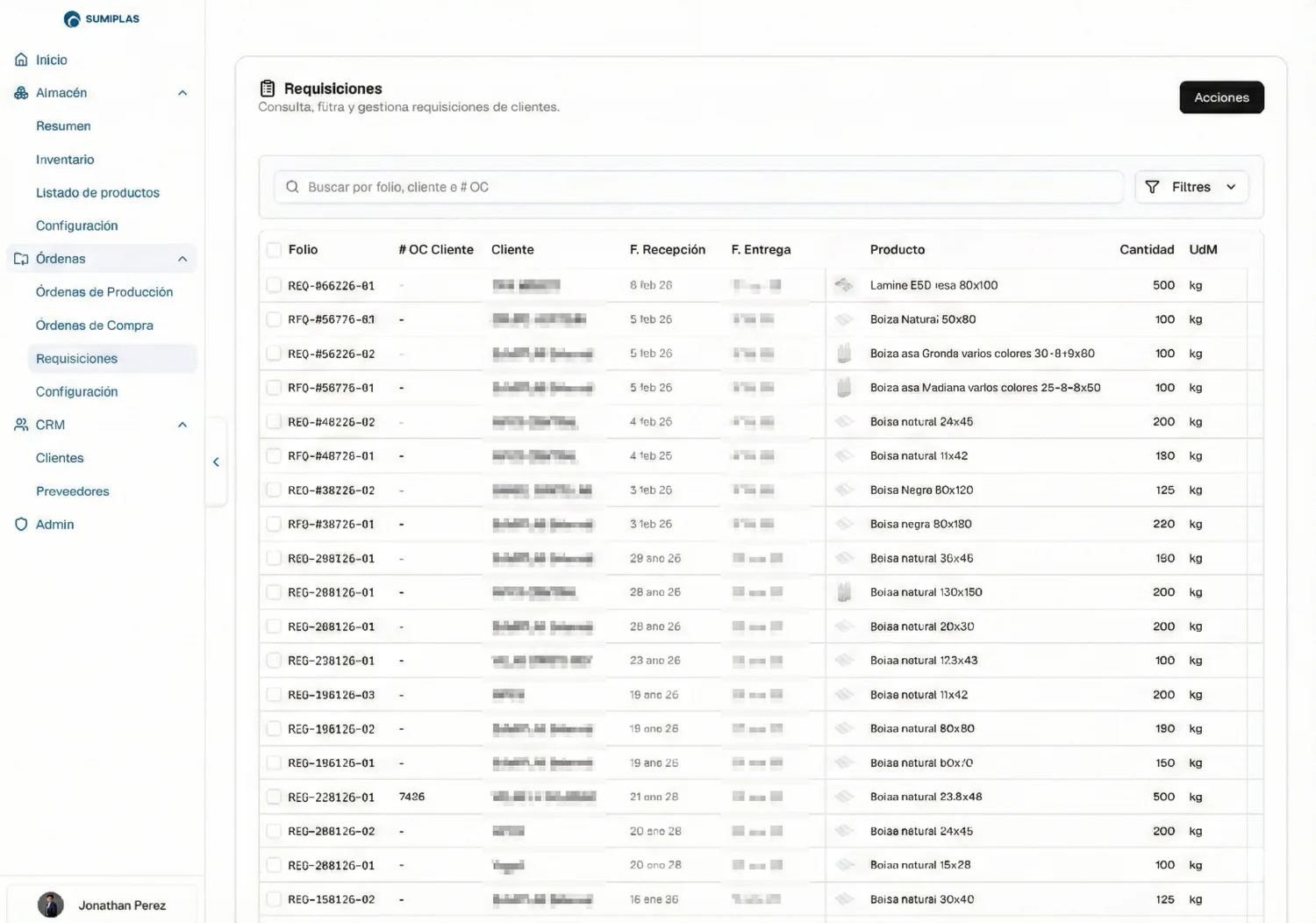
A specific adjustment may take hours; a small module, about a week with data and access ready. Migration and testing for a complete system need a staged schedule. A complete system arrives in stages, each dated in writing, and your team uses whatever a stage brings from the day it’s received. During development, you can continue with your current workflows. Before putting each stage into use, we agree on the data cutover, opening-balance validation, any required change windows, and how movements during rollout are recorded and reconciled. We bring the part numbers, customers and stock included in scope over from Excel and validate them before use. Screens are designed for the people who use them on the floor. For reference, there’s Polymer, Sumiplas’s system: it tracks every order from raw material to delivery, measures each machine’s efficiency and shows where material is wasted.
If something we delivered fails and you report it within 60 calendar days of that delivery, we fix it at no cost. If you decide to stop the project, you pay only for the work done up to that point. And your batch, order, shipment and customer data is yours to export whenever you need it, for example for a customer audit or to switch systems.
The source code we develop specifically for your company belongs to you, just like your data. Your custom software has no user limit or per-user charge from Nightly. Each person signs in with their own permissions. Development is paid in stages. Hosting, maintenance, support and third-party services are agreed separately in the proposal. Code delivery is part of the project. The proposal defines how it is delivered and which documentation and access are included. Nightly products and third-party components and platforms retain their own licences and terms.
We’ll tell you what to fix first and what it would cost. We reply the same business day.