01
Free consultation
We talk about your operation, in person in the Bajío region or by video call everywhere else, and identify what to fix first.
Manufacturing software built around your plant: every production order with a number and an owner, materials deducted automatically, quality and lot traceability, machine maintenance and simple screens for the shop floor. For factories, workshops, maquiladoras and suppliers that run on spreadsheets, paper and WhatsApp today.
The problem
If any of these sound familiar, it’s worth a conversation. The consultation is free.
You know what you sold, but not how much material, scrap and machine time each order took.
When a customer or an auditor asks for the lot, the material and who made it, someone has to dig through binders and files.
Maintenance happens when something stops, not when it’s due.
What gets written on paper in production reaches the office computer late, or never.
You find out you’re short on material when the order is already on the machine, so you buy in a rush and pay more.
If they’re out for a day, nobody knows which order is next or what material it needs.
What’s included
We start with the process that costs you the most today, such as production orders or materials control, and add the rest in stages without stopping the plant. If you’re in Irapuato, León, Celaya, Silao, Querétaro or Aguascalientes, we’ll walk your floor in person; anywhere else in Mexico, we’ll go over it by video call.
From the customer’s order to the production order, with machine, shift, person in charge and due date.
Raw materials, supplies and finished goods. What each order uses is deducted automatically, and scrap is recorded.
Inspections, rejects and the material lot in every shipment, with a log of who changed what.
A preventive maintenance calendar, downtime logged with its cause and the history of every machine.
Customers see where their order stands and suppliers get their purchase orders, without phone calls.
Tablets or computers in each area to log progress, downtime and scrap in seconds, with barcodes if you use them.
How we work
No commitment and no jargon. You get everything in writing before we start.
01
We talk about your operation, in person in the Bajío region or by video call everywhere else, and identify what to fix first.
02
You get the scope, price and timeline in writing, split into stages.
03
We build in stages, you review progress at every delivery and we keep improving the system with you.
What business owners ask us before getting started.
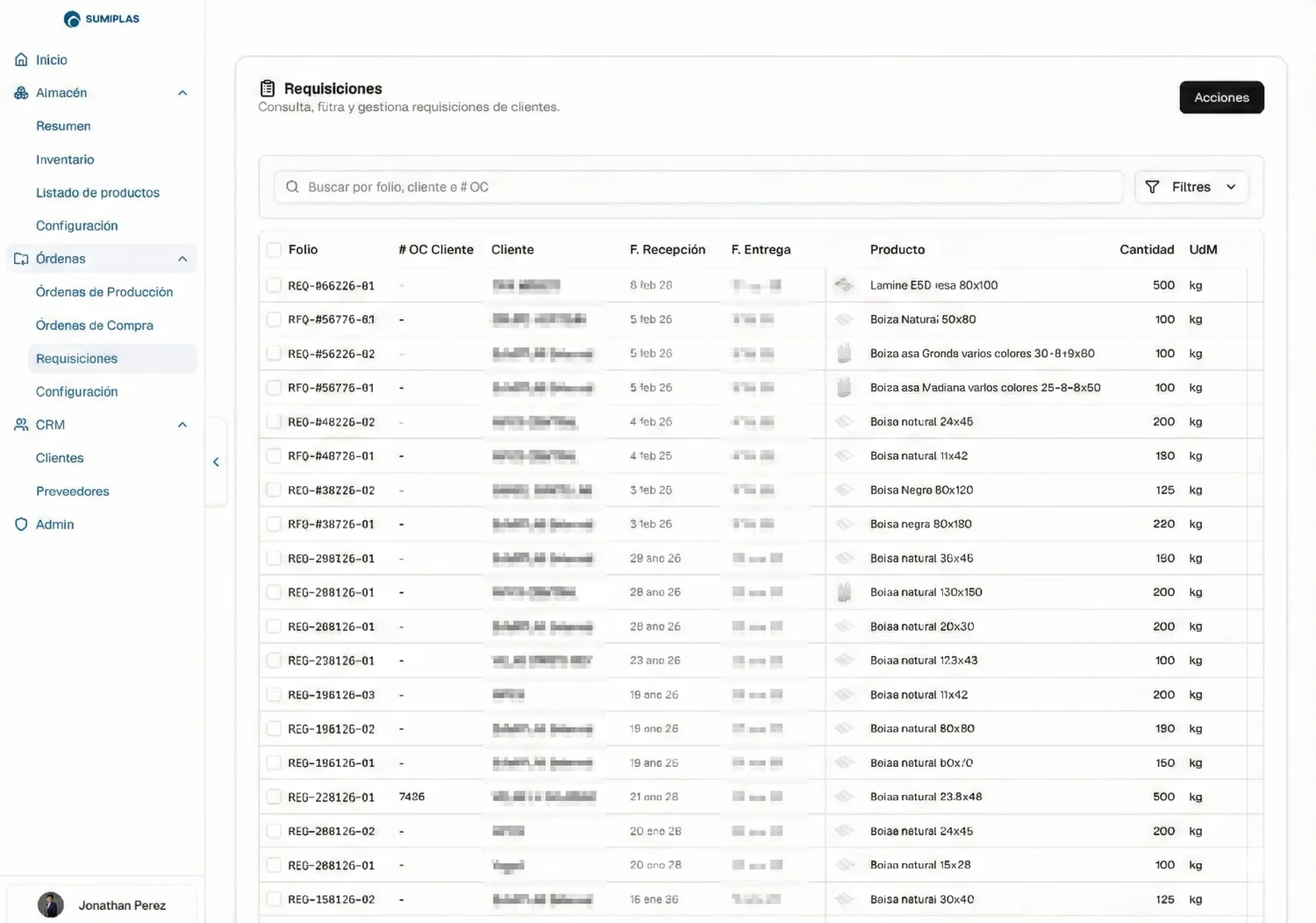
Whatever your plant needs, and not all at once. The usual pieces: customer orders turn into production orders; each order deducts the materials it uses and records its scrap; quality logs inspections and rejects by lot; maintenance keeps the calendar and history of every machine; and management sees efficiency and on-time deliveries on dashboards. One example is Polymer, the system we built for Sumiplas, a plastic bag factory with a wide product range that ran on Excel. Today its production, inventory, staff and customers live in one system, it sees the progress of every order in real time, and it has efficiency metrics for each machine to make better decisions.
Close. A custom manufacturing ERP brings purchasing, inventory, production, sales and reporting into one system, built around how your plant works rather than the other way around. You don’t always need to replace everything: if your accounting or invoicing system works for you, you keep it, and we connect the plant system so each piece of data is entered only once. If an off-the-shelf ERP covers your process as it comes, we’ll tell you in the consultation. Custom software makes sense when the way you produce is part of your edge: your own formulas, batch processes, products with many variants or customers who ask for specific reports.
It depends on how many areas you want to cover. A single module, such as production orders or materials and scrap control, can start from about $5,000 MXN. Connected production and inventory, from about $15,000 MXN. A complete system with orders, production, materials, quality, maintenance and reports, from about $25,000 MXN, paid in stages. Adjustments and support start at $400 MXN per hour. You get the exact price in writing after the free consultation, with each stage priced separately so you know what you’re paying for each part.
Yes. Manufacturing carries a lot of weight in Guanajuato: according to INEGI’s 2024 Economic Census, it produced 65.1% of the state’s value added in 2023, almost twice the national share (34.4%), and the three activities whose value added grew the most between 2018 and 2023 were all auto parts. INEGI also ranks Guanajuato fifth among Mexican states by number of IMMEX establishments, with 6.5% of the total in July 2026. If your plant is in the IMMEX program, Mexico’s foreign trade rules require automated inventory control of your temporary imports, with the minimum information set out in Annex 24. Before we build, we look at the system you use for that, so production and materials connect to it and nothing gets entered twice.
Every incoming material gets its lot number on arrival. When a production order uses it, the system records which lot went in, on which machine, during which shift and who worked on it, along with the quality inspections. When you ship, the delivery carries the lot of the finished product. If a customer reports a defective part, you look up the lot and see in seconds where it came from and which other shipments carry the same material, instead of going through binders. Polymer, the Sumiplas system, is aligned with ISO 9001 and was designed with a certified lead implementer. Your plant’s certification is granted by a certification body; the system helps you keep the records they’ll ask for at hand.
Yes. The shop floor isn’t an office, so production screens have few buttons, large text and only what each station needs: start an order, log progress, report downtime with its cause or record scrap. They run on tablets or computers in each area, and if you use barcodes, operators scan the order or lot instead of typing it. Each person sees only their part, and every entry is saved with a name and time. In the review of each stage, we adjust the screens based on what your team tells us.
Yes, each with their own login and access only to what’s theirs. Customers see where their order stands, download their quality certificates or invoices and send you new requisitions; suppliers receive their purchase orders and confirm delivery dates. Executive Engineers, an industrial consulting firm that works with manufacturing leaders, shares projects, progress and documents with each client through a secure portal, keeps its files in its own cloud, and follows ISO 27001 standards for security. And if you make to order, quotes can live there too: Translate3D, a digital manufacturing business that used to run everything by hand, now has its own online store and a dashboard for inventory, tracked quotes and orders.
No. We solve urgent issues within hours, and most projects are ready in about a week. A complete system for your plant is delivered in stages, each with its date in writing: the first covers what you need most, and your team starts using it while we build the rest. We move the information from your spreadsheets into the system, as we did for Sumiplas, so nobody starts from scratch. We fix any defect you report within 60 calendar days of each delivery at no cost, you can end the project whenever you want, paying only for the work done, and your orders, lots and production history are always yours to export.
In a free consultation we’ll tell you what to fix first.
Free consultation
Tell us how your team works. In one call we’ll tell you what to fix first.