01
Free consultation
We talk about your operation, in person in the Bajío region or by video call everywhere else, and identify what to fix first.
For carriers that move other companies’ freight, with 5 to 100 units: you quote freight with your rates by route, assign the truck, driver and trailer, enter the Carta Porte data once and get proof of delivery from the driver’s phone. When each trip closes, you know what it made you.
Companies that already trust Nightly














The problem
If any of these sound familiar, it’s worth a conversation. The consultation is free.
Only they know the rates by route, what the tolls cost and what each customer was charged last time.
Customers call and message to find out where their trip is, and someone has to phone the driver to answer them.
Origin, destination, goods, truck and driver get typed again on every invoice, and a mistake surfaces once the truck has already left.
Signed delivery slips come back in the glove box, and without them your invoice and your customer’s payment are delayed too.
Diesel, tolls, meals and advances arrive on scraps of paper, and closing each trip takes hours of office time.
You invoice the freight, but diesel, tolls and driver pay sit in separate places, and the profit only shows up at month-end, if at all.
What’s included
According to the 2025 Basic Federal Trucking Statistics from SICT, Mexico’s transport ministry, at the close of 2025, 79.9% of the country’s 224,239 freight trucking companies were micro businesses with 1 to 5 units. Competing with the big carriers doesn’t take their budget: it takes recording each trip once, from the moment the customer asks for a quote until they pay you. We build it around your routes, your customers and the way you settle with drivers, and start with what costs you most today.
Your rates by route, truck type and customer, with estimated tolls and diesel, so you can quote freight in minutes even when your usual quoter is out.
Every trip with its truck, trailer, driver, pickup and delivery appointments and status, visible to the whole office.
Origin, destination, goods, truck and driver are entered once on the trip; stamping goes through your billing system or your PAC (the provider that stamps your invoices).
Photo, signature and delivery time from the driver’s phone; your customer sees it in a portal without having to ask.
Advances, diesel, tolls and receipts for every trip, so you can settle with each driver with clear numbers.
What you charged against what you spent on each trip, and which customers, routes and trucks earn you the most.
In detail
If you already have a TMS, the system that manages your trips, check what is missing before replacing it.
| What limits you today | First stage to evaluate |
|---|---|
| Your TMS invoices correctly, but delivery evidence returns on paper | Evidence capture and a customer portal linked to the existing trip reference. |
| You have GPS, but nobody connects the location with a trip | A read connection to your provider, if your plan and its permissions allow it. |
| Advances and expenses live in separate files | Trip settlements with receipts, approvals and the detail administration needs. |
| There is no shared trip record | Truck and driver scheduling with statuses and responsible staff; integrations follow. |
Bring one completed trip: its quote, reference in your system, advance, expenses, delivery evidence and billing document. A real example lets us find repeated entry and what needs connecting. For GPS, invoicing and fuel, we first check the version, permissions, information access and any provider fees.
Before accepting a stage, test a truck change, a duplicate receipt and a delivery without signal. Check who can correct each record, how the history is preserved and what happens when the connection returns. A GPS point alone is not a confirmed delivery: the rule that changes the status and the required evidence are agreed in the scope.
The goal is an office that consults the same trip while retaining what already works in your invoicing. To connect purchasing and balances too, see custom ERP; for customer access, see customer portal.
In detail
What the SAT and Mexico’s driving-time standard say today, checked on October 5, 2026.
According to the SAT, Mexico’s tax authority, version 3.1 of the Carta Porte complement (the bill-of-lading data attached to the CFDI electronic invoice) has had to be used since July 17, 2024, and in foreign-trade operations the invoice with the Carta Porte complement has been required since January 1, 2024. Much of what that complement asks for, such as origin, destination, goods, truck and driver, is what your office already writes down to schedule the trip. The system takes it from there and passes it to your invoicing, so nobody types it twice.
NOM-087-SCT-2-2017, published in Mexico’s Official Gazette (DOF) on June 28, 2018, requires drivers to carry an hours-of-service log, printed or electronic. It sets a 30-minute break after up to five continuous hours of driving and, for freight, a rest of at least 8 continuous hours on routes with up to 14 hours of driving, which is the maximum in 24 hours. The system can record those hours with each trip, so the log, the schedule and the driver settlement all come from the same data.
Pricing
Starting-price references. The exact price comes in writing within 1 business day of the free consultation, and you pay in stages, not for the whole system up front.
How we work
No commitment and no jargon. You get a written proposal within 1 business day of the consultation.
01
We talk about your operation, in person in the Bajío region or by video call everywhere else, and identify what to fix first.
02
You get a written proposal within 1 business day of the consultation, with the scope, price and timeline split into stages.
03
We build in stages, you review progress at every delivery and we keep improving the system with you.
Projects
In writing
That’s what our terms say · How we work
We fix, at no cost, anything that doesn’t work as agreed and that you report within 60 calendar days of each delivery.
You can ask us for a full export at any time, including when the project ends.
We use what you share about your business only for your project and, if you need it, we sign a confidentiality agreement before we start.
If you ask for something outside the proposal, we first tell you in writing how it changes the price and dates, and we only do it if you approve.
When each stage arrives, you review it and tell us anything that doesn’t match what we agreed. We fix that at no cost.
Let us know in writing and you pay only for the work done up to that day.
What business owners ask us before getting started.
Whatever your operation needs, starting with what costs you most. The usual pieces: quotes with your rates by route, trip scheduling with truck, driver and trailer, the Carta Porte data, proof of delivery from a phone, each driver’s expenses and settlement, and the profit on every trip. It can also warn you before the insurance policies, inspections and licenses of your trucks and drivers expire. It’s designed for companies that move other people’s freight. If you deliver your own goods, a distribution management system fits better, and if you store or supply goods from Puerto Interior, see custom software in Silao.
A single module, such as quotes with your rates by route or proof of delivery from a phone, can start from about $5,000 MXN. Trips, Carta Porte data and driver settlements connected, from about $15,000 MXN, and a complete system that adds the customer portal and the profit on every trip, from about $25,000 MXN, paid in stages. Adjustments and support start at $600 MXN per hour. You get the exact price in writing within 1 business day of the free consultation, with what each stage includes and its date. If getting paid on time is what hurts most, also read our collections system guide.
It prepares the data and sends it to be stamped. The system builds the CFDI Carta Porte 3.1 complement data from what was already entered on the trip, such as locations, goods, truck, trailer and driver, and sends it to your billing system or your PAC, the SAT-authorized provider that certifies invoices, which is who stamps it. If you invoice with CONTPAQi, Aspel or another system today, we connect it when your system allows it. That way, the data your office uses to schedule the trip is the same data on the invoice, and a last-minute change gets fixed in one place.
Yes. Each customer logs in to a customer portal and sees their trips: scheduled, on the road or delivered, with the proof of delivery as soon as the driver uploads it. They can also get WhatsApp updates when their trip changes status. We already work this way at TramitesLegalesMX, an online paperwork platform where clients, distributors and administrators all see the same status for every order. Every question the portal answers is one less call for your office.
Yes, if your GPS provider offers an API, meaning a connection that lets another system read your trucks’ locations. We check it with your provider during the consultation, before quoting. With that connection, each truck’s location shows up next to its trip, and the status can change on its own when the truck reaches the delivery point. If your GPS doesn’t offer one, the driver marks departure, arrival and delivery from their phone, and your customer still sees it in the portal. We’re currently building GPS tracking, an operations ERP and fuel management for a transport company.
Yes. Each trip carries its advance, and the driver uploads a photo of every diesel, toll or expense receipt from their phone. When the trip closes, the system adds up what was receipted, compares it with the advance and works out what the driver is owed or has to return, under your rules: per trip, per kilometer or as a percentage of the freight. With the liters loaded and the kilometers of each trip you see every truck’s fuel efficiency, and a diesel load that doesn’t add up stands out without going through paperwork. How payroll is paid is still up to your accountant.
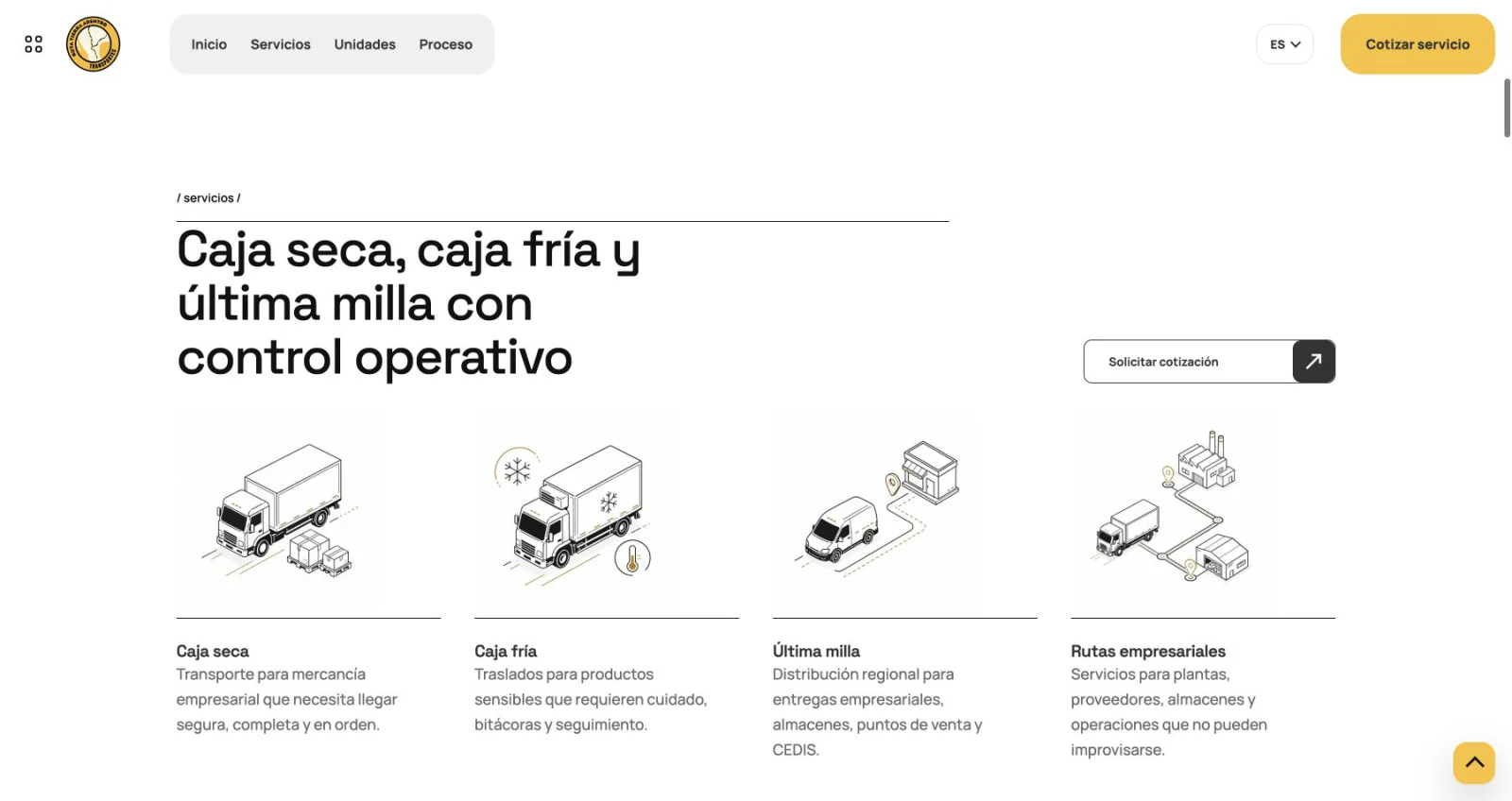
Ruta Tierra Adentro Transportes is a trucking company in Irapuato that offers dry and refrigerated freight, last-mile delivery and corporate routes. We built them a website in six languages (Spanish, English, Japanese, Chinese, German and French) to present themselves to companies in different countries, with quote forms designed for businesses, and they got new inquiries from the first week. We also set up a commercial base with target accounts, a sales pipeline and follow-up on every prospect, plus indicators for contacts, quotes, trips and repeat customers. It was their website and commercial base, not a trip system: we say so plainly so you know exactly what we did. See the Ruta Tierra Adentro case study.
Yes. We’re based in Irapuato and come to your yard or office in Silao, Celaya, León, Salamanca, Querétaro and the rest of the Bajío, to see how you schedule trips today and who enters each piece of data. According to SICT’s 2025 Basic Federal Trucking Statistics, at the close of 2025 the federal freight fleet in Guanajuato added up to 87,925 motor units, and 11,098 individuals operated freight trucking in the state as sole proprietors. If you’re in another state, we work by video call. Also see our pages on custom software in Silao and in Celaya.
We’ll tell you what to fix first and what it would cost. We reply the same business day.